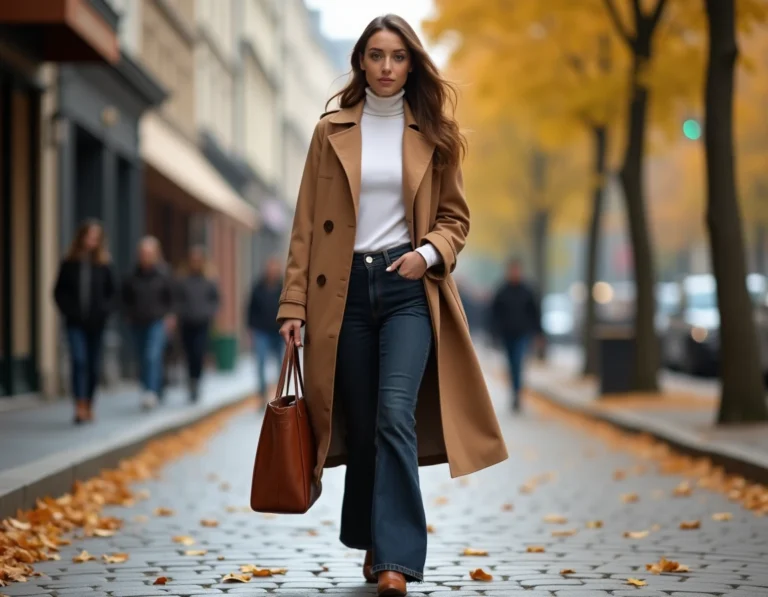
Creating a personal style requires a different editorial approach than simply relaying trends. A method focused on personalization changes the very nature of the content offered.
Personalized look method: what separates style advice from mere trend relaying
Generic fashion content suggests pieces to buy. Personalized content offers a framework for reflection: body shape, personal color palette, coherence between clothing and lifestyle. The difference is structural.
When we analyze the fashion section of Michelle Dastier, it is precisely this methodical logic that captures attention. The approach is not about dictating a ready-made look, but providing tools for each reader to build their own.
Unique style arises from a process, not a shopping list. Short formats like Instagram carousels or “top 10 pieces of the season” articles rely on the constant renewal of product references, which prevents them from addressing the construction of a sustainable style.
Evaluation grid for a fashion section oriented towards personal style
Not all sections that claim uniqueness of style hold the same promise. We recommend checking a few concrete criteria before spending time on any fashion content.
- Presence of a morphological or colorimetry framework: does the content explain how to adapt a piece to one’s silhouette, or does it merely show a model?
- Independence from commercial calendars: do the articles follow spring-summer and autumn-winter collections, or do they offer principles applicable year-round?
- Ability to address the existing wardrobe: quality personalization sections help recombine what one already owns, not just acquire new items.
- Absence of systematic affiliate links: when every mentioned piece leads to a commercial site, the advice loses its neutrality.
This last point is a reliable marker. Content that monetizes every clothing recommendation has an objective interest in pushing for renewal, which directly contradicts the construction of a sustainable style.
Building a coherent wardrobe without following seasonal trends
Seasonal fashion operates through the planned obsolescence of taste. A color is declared “trendy,” worn massively for six months, then replaced. This mechanism does not serve the construction of a personal style.
We observe that a coherent wardrobe rests on three stable pillars:
- A limited palette of compatible colors, chosen based on skin tone and actual preferences (not the Pantone predictions of the year).
- Cuts that correspond to body shape and desired comfort, identified once and then repeated.
- A controlled ratio between basic pieces and statement pieces, generally around a majority of basics with a few strong pieces that carry the uniqueness of the look.
The real work of style consists of reducing options, not multiplying them. This is counterintuitive in a media environment that values constant novelty, but it produces a wardrobe where each piece works with the others.

The trap of the misunderstood “capsule wardrobe”
The concept of a capsule wardrobe has been widely circulated in recent years. In its simplified version, it boils down to a list of standardized pieces (a trench coat, a pair of raw jeans, a white t-shirt). The problem is that this list remains the same for everyone, without considering individual tastes, climate, or daily life of the person following it.
An effective personalization method starts from the opposite: first identifying what one enjoys wearing spontaneously, analyzing why certain outfits provide a sense of correctness, and then extracting constants. Style is discovered through self-observation, not by applying a formula.
Checking if fashion content provides a real editorial difference
In the face of the mass of fashion content published every day, an informed reader needs filters. An article or section truly stands out when it meets at least two conditions.
The first: the content remains relevant six months after its publication. If a style article no longer works because the season has changed, it was part of seasonal marketing, not substantive advice.
The second: the reader leaves with a tool applicable to their own wardrobe. Good personal style content does not just inspire; it provides a framework for understanding. For example, explaining how to test if a pair of pants fits one’s silhouette by checking three specific points (fall at the ankle, waist position, volume at the thighs) is more valuable than a carousel of looks to replicate.
The role of long-form editorial content
Short formats (reels, stories, posts) dominate current fashion prescriptions. Their limitation is structural: in fifteen seconds, one shows a result, not explains a process. The article format, slower, allows for detailing the reasoning behind a clothing choice.
It is in this space that editorial sections oriented towards style personalization make the most sense. The text allows for nuance, distinguishing what works on a model from what will work for the reader, and posing questions that the image alone cannot formulate.
A personal style cannot be copied from a screen. Each clothing decision, from choosing a cut to removing an unnecessary piece, gradually refines the coherence of the wardrobe. A fashion section that conveys a method rather than a product selection enables the reader to make their own choices, independent of the editorial calendar.