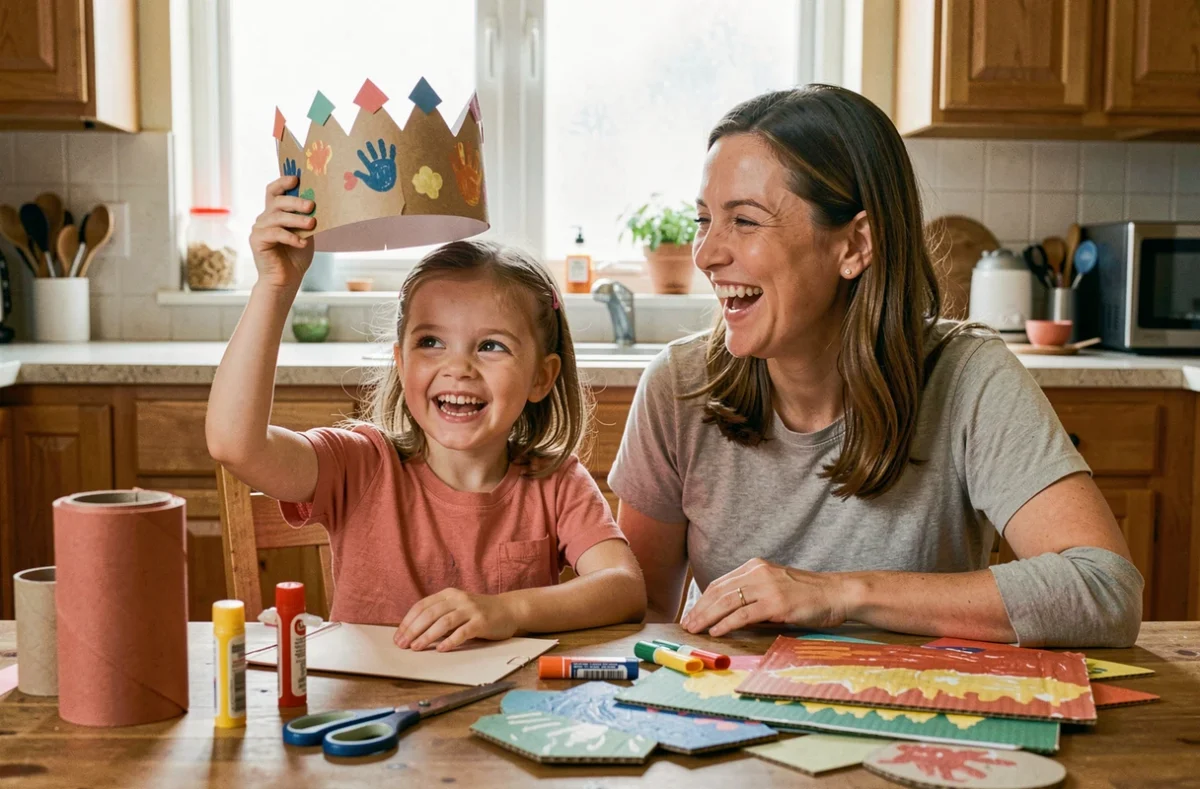
A fun and creative activity doesn’t need to be spectacular to make a mark on a child’s daily life. What matters is the quality of the interaction during the shared time. Recent public health research highlights a often overlooked angle: parental technoférence, meaning the repeated interruptions caused by the parent’s phone during moments spent with the child, can degrade the quality of these exchanges just as much as excessive screen time for the child themselves.
Parental technoférence and shared activities: setting the stage before playing
Before choosing an activity, the first step concerns the parent. Recent recommendations no longer focus solely on children’s screen time: they emphasize that the parent must also put down their phone for the interaction to be truly beneficial.
The principle is simple. Define a short time slot (twenty minutes is sufficient) during which the phone remains in another room, on silent mode. It’s not a matter of willpower; it’s a matter of configuration: as long as the phone is within reach, notifications create micro-interruptions that break the flow of play.
On pcommeplimplim.com, the activities offered to families are based on short and engaging formats, suitable for these real availability slots.
With this framework established, the choice of activity becomes secondary. A simple construction game with cardboard boxes, conducted with the parent’s full attention, has a greater impact on the child’s language and emotional regulation than a sophisticated workshop where the adult checks their screen every three minutes.
Free play without instructions: why less direction stimulates more
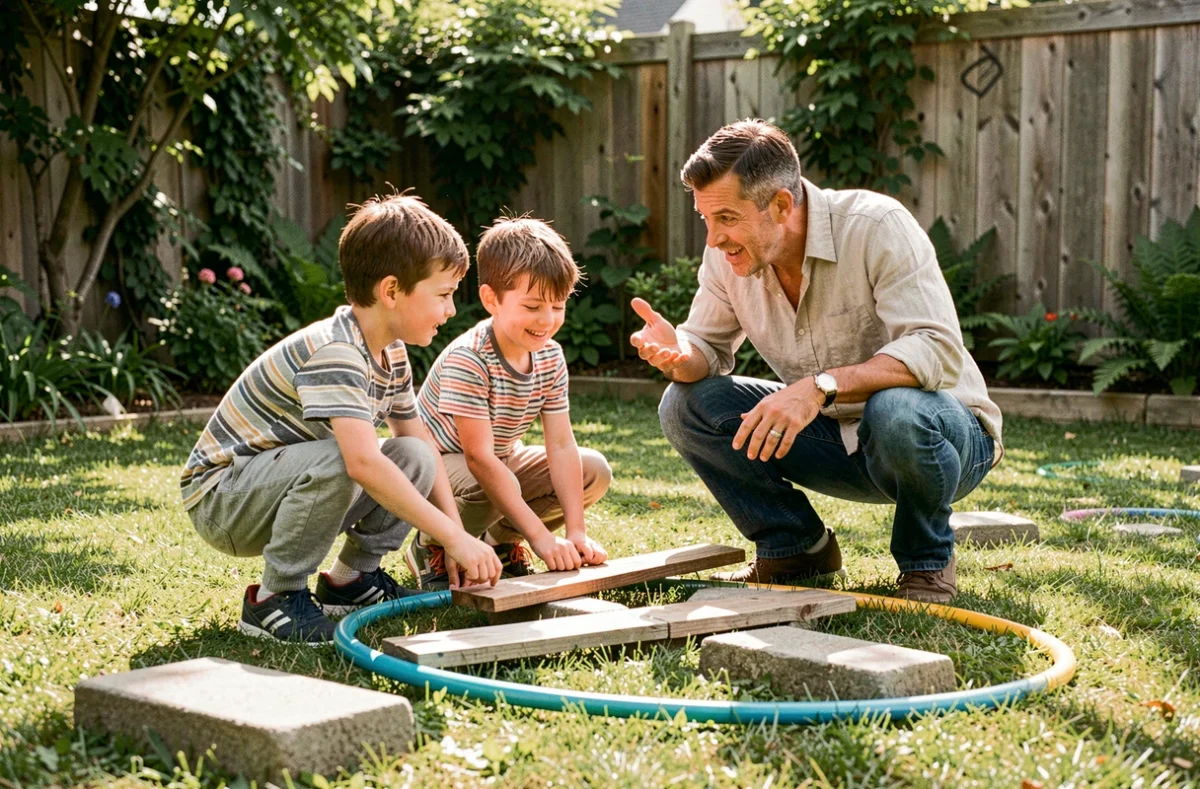
The majority of children’s activity lists offer guided projects with an expected outcome. Directed painting, step-by-step crafts, recipes to follow. These formats have their place, but they leave little room for free play not directed by the adult.
Recent summaries on child development highlight unstructured play as a simultaneous lever for motor coordination, language, and emotional management. The principle: the child decides the rules, the pace, and the goal. The adult observes, responds to requests, but does not take control.
Setting up a free play space at home
No specialized equipment is needed. The goal is to gather various objects in a defined space and let the child combine, invent, and test.
- Gather recycled items: paper rolls, bottle caps, fabrics, boxes of different sizes, wooden spoons. The heterogeneity of textures and shapes fuels exploration.
- Define a clear perimeter (a corner of the room, a rug) so the child knows where their play territory is. This spatial limit, paradoxically, frees the imagination.
- Resist the urge to propose a project. If the child stacks bottle caps on a roll for ten minutes, that’s already a work of concentration, balance, and planning.
- Intervene only when the child asks. A simple “what are you making?” can be enough to restart a phase of exploration that seemed to stagnate.
This type of play works particularly well in small living spaces. It requires neither purchase nor lengthy preparation, making it accessible regardless of family situation.
Free creative activities suitable for small spaces
Public Health France notes that children of less educated parents spend more time in front of screens and more often have a screen in their room. Offering costly creative alternatives or those requiring large spaces effectively excludes some families.
Music and rhythm with kitchen materials
Two upside-down pots, a wooden spoon, and a tupperware filled with rice form a sufficient percussion kit for a musical session. The rhythm works on bilateral coordination, meaning the ability to use both hands in a coordinated way, a skill directly linked to learning to write.
The parent can propose a simple rhythm (two slow beats, one fast beat) and the child replicates it, then invents their own. This alternation between imitation and creation structures the session without making it rigid.
Collaborative drawing on recycled paper
Take a sheet of paper (the back of a printout, an open paper bag, a paper tablecloth). The parent draws an abstract shape, and the child transforms it into a character or landscape. Then, roles are reversed.
Each participant builds on what the other has started, which develops cognitive flexibility. The child learns to integrate an external constraint into their own project, a skill useful far beyond drawing.
Home escape game for children: transforming the interior into an adventure ground
A family escape game requires neither a commercial kit nor hours of preparation. The principle is based on a series of simple puzzles hidden around the apartment or house, with a narrative thread invented together.
Three or four puzzles are sufficient for a session lasting twenty to thirty minutes. A word hidden under a cushion leads to a riddle stuck on the refrigerator, which indicates the location of a puzzle to be reassembled. The difficulty adapts in real-time: if the child gets stuck, the parent slips in an additional clue.
The interest of this format goes beyond entertainment. The child engages reading (even at a beginner level), logical reasoning, and spatial memory. The parent, on the other hand, is fully engaged in the interaction as they facilitate the game.
For families wanting to renew the exercise, a notebook of reusable puzzles (riddles, color codes, hand-drawn mazes) allows for creating a new path each week without needing to purchase new materials.
The most effective activity for a child is not the one that costs the most or requires the most preparation. It is the one where the adult is fully present, where the materials allow for improvisation, and where the child retains the freedom to bend the rules. Family life is already full of everything needed to play: sometimes, you just need to close a drawer of notifications to open one of creativity.